About The Great Wall of China
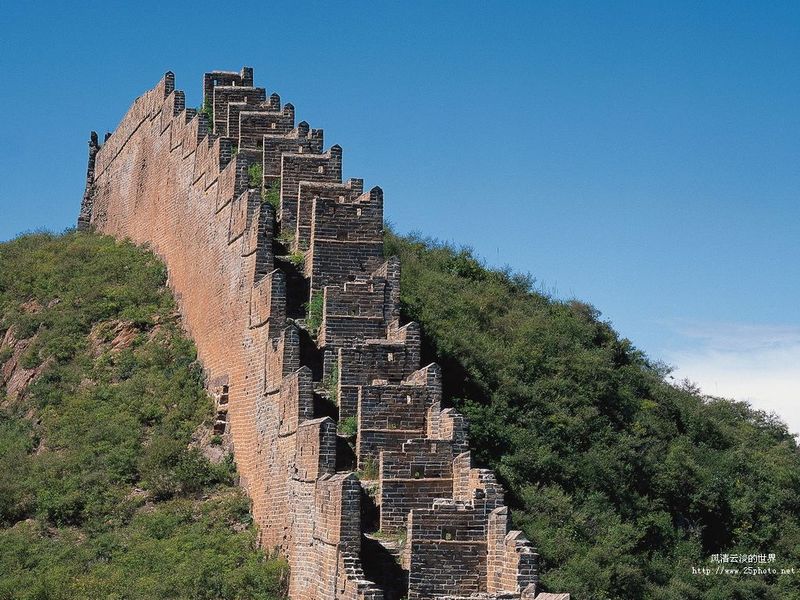
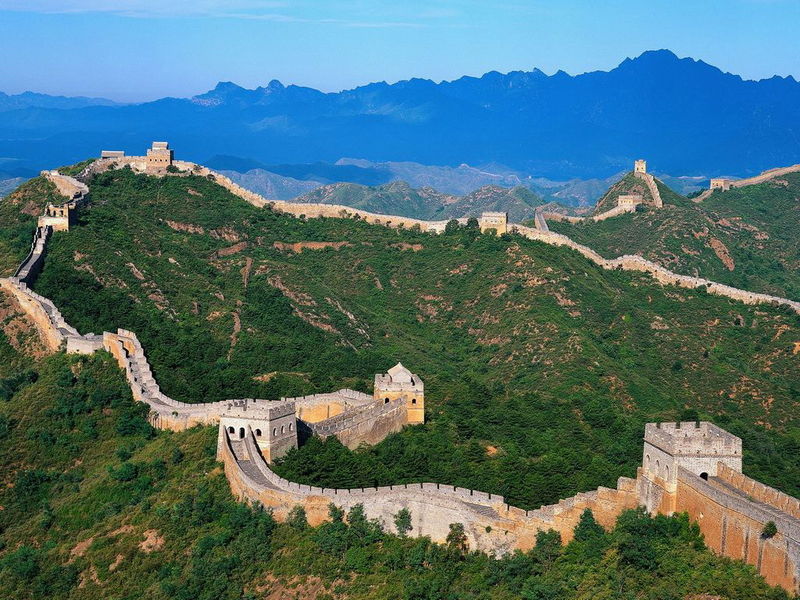
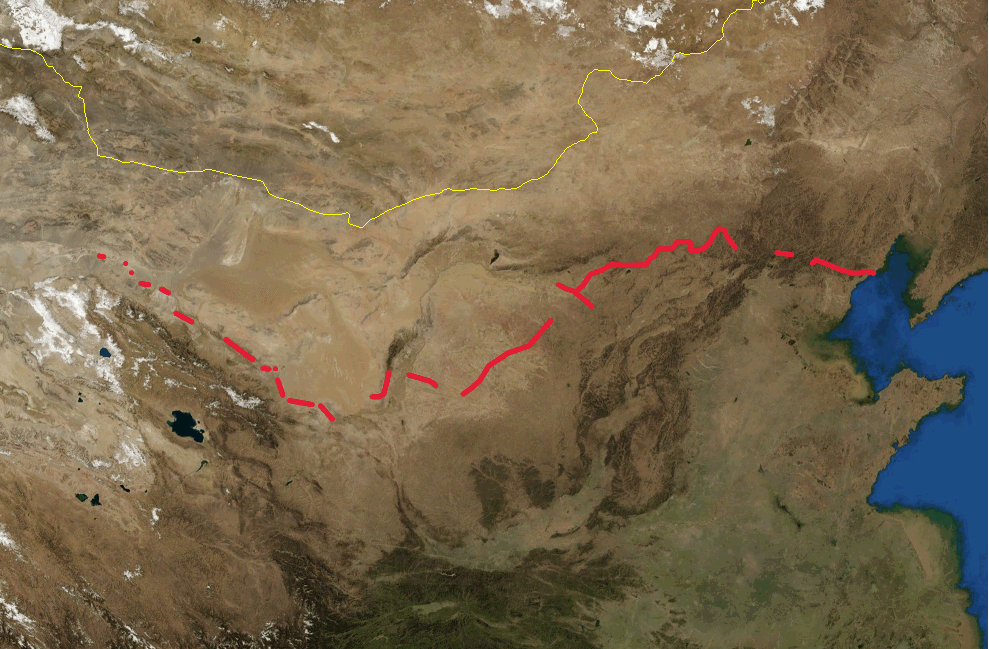
The Great Wall is very long, it crossed more than half of China. The Great Wall is starting out in the east on the banks of the Yalu River in Liaoning Province. The Wall stretches westwards for 12,700 kilometers to Jiayuguan in the Gobi desert, thus known as the Ten Thousand Li Wall in China. The Wall climbs up and down, twists and turns along the ridges of the Yanshan and Yinshan Mountain. Chains through five provinces—Liaoning, Hebei, Shanxi, Shaanxi, and Gansu—and two autonomous regions--Ningxia and Inner Mongolia, binding the northern China together(China Through A Lens).Great Wall is most build cross plains, mountains, and plateaus. Parts of the Great Wall are crossed the desert. “One of the highest sections of Great Wall is on the Badaling mountain, near Beijing. This section is about 35 feet, which is about 11 meters high, the wide at its base is about 25 feet(7.6 meters) and near 20 feet (6 meters) on the top. The watchtowers stand about 100 to 200 yeads (91 to 180 meters) apart along the wall. (Kai-Wing, Chow).” Watchtowers were made for people to look out at war time, so they can know when enemies come. It is about 40 (12 meters) feet high.
Thousands of years ago, Chinses people began to build the Great Wall. The building of the Great Wall was begin as early as the 600’s BC, at that time, the Great Wall was built to protect Chinese against invaders. Qin Shi huang, Emperor of Qin dynasty is the first ruler to conceive of the Great Wall. The building continued including the Han and the Sui dynasties. When the Ming dynasty bagan in 1369, much of the Great Wall have been crumbled. Because of the growing threat of a Mongol invasion, the Ming government began to build a major wall in late 1400’s. This is most of the wall that remains today. Like the earlier one, it protected China from attacktion and it also provided defense against a major invasion. Through the years, much of the Great Wall collapsed again. And the Chinese Communist have done all the restoration works since 1949(China Through A Lens).greatwall of China
The wall is about 4,000 miles long. And it is simple in structure. The Great Wall is built out of dirt, stone, and brick.() Most of the Great Wall is carried out by humans, and a lot of people died because of the building of the Great Wall(Aladdin, Paperbacks).“Its height ranges from 15 to 30 feet, with watchtowers rising at regular intervals above it. It is 15 to 25 feet wide. Along the top runs a 13-foot-wide roadway. Behind the wall there are at intervals permanent camps for troops.”(Tim, McNeese).
Today, the Great wall has lost its strategic importance and has become a world-renowned tourist attraction.
As a cultural heritage, the Wall belongs not only to China but to the world. The Venice charter says: “Historical and cultural architecture not only includes the individual architectural works, but also the urban or rural environment that witnessed certain civilizations, significant social developments or historical events." The Great Wall is the largest of such historical and cultural architecture, and that is why it continues to be so attractive to people all over the world. In 1987, the Wall was listed by UNESCO as a world cultural heritage site.
Cool! 3D digital Great Wall to go online
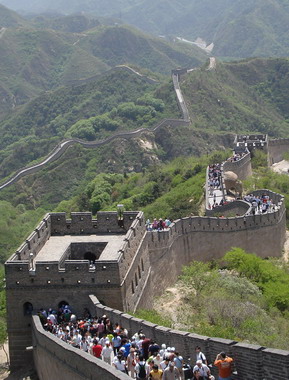
This undated photo shows part of the Badaling section of the Great Wall near Beijing.
The digital version will be constructed from data obtained through a near-finished photographic mapping of the sections in nine provinces, autonomous regions and municipalities in northern China, the bureau said.
The Great Wall was originally built by China's first emperor Qin Shi Huang (259-210 BC), who also built the Terra Cotta Warriors in his grand tomb, but most of the surviving walls that are visited today were built in the Ming Dynasty, about 600 years ago.
The Ming Dynasty portions are scattered across the northern part of the country, including the famous Badaling and Mutianyu sections in suburban Beijing.
The bureau said it would soon announce the total, accurate length of the surviving sections.
Travel in China
22 august 2007
- Tiananmen Square
The Tiananmen Square in the center
of Beijing, is said to be the biggest
square in the world. It is has a total
area of 440,000 square meters and
can hold one million people.
The granite Monument to the People’s
Heroes is just at the center of the
Tiananmen Square. Built in 1952, it is
the largest monument in China’s history.
- Forbidden City
The Forbidden City, located at the center of the ancient city of Beijing, was home to 24 emperors during the Ming and Qing dynasties. Surrounded by a six meter deep, and a ten meter high wall are 9,999 buildings. Construction of the palace complex began in 1407 and was completed fourteen years later in 1420.
Today, the Forbidden City is a World Heritage. At the Forbidden City you can see the traditional architecture up close and marvel at the treasures of the imperial family and its court.
20 august 2007
- Summer Palace
The Summer Palace has a history of over 850 years. The Imperial garden has existed since 1150. The gardens that surrounded the Summer Palace date from the Jin Dynasty (1115-1234).
The Summer Palace was used as a summer residence by China’s Imperial rulers, as a retreat from the main imperial palace now known as the Forbidden City. For the emperor the summer palace was a pleasure ground in the countryside, yet near to the city.
18 august 2007
- Old Summer Palace
The gardens of the Old Summer Palace, which are about the same size as Central Park in New York, date back to the 12th century. Emperor Qianlong who was inspired by French and Italian palaces and had 10 palaces of his own designed and built in rococo style in the gardens.
When the British and French were unhappy with the Chinese government’s refusal to accept opium in return for silk, tea and other goods, the Europeans destroyed the 10 palaces of the emperor. The destruction occurred over three days in 1860 during the Second Opium War (1860-1862). The troops burned all the wood structures and did as much damage to the marble facades as they could.
The Old Summer Palace which is known as the Ruins of the Yuanmingyuan (the Garden of Perfection and Light) was also called the ‘garden of gardens’ or the ‘Versailles of the East’ in Europe. Hundreds of scenic spots in the Garden are made up of exquisitely constructed, earth and rock hills, rivers and ponds, exotic flowers and grasses, Grand Waterworks, and a Labyrinth. The Old Summer Palace embodies the essence of Chinese ancient landscape gardening.
15 august 2007
- Great Wall / Chinese Wall
To reach Mutianyu Great Wall there are more than 1,400 steps to climb. Mutianyu Great Wall enjoys a long history and is part of the glorious culture of China.
The wall was first built in Northern Qi Dynasty (550 - 557). In the Ming Dynasty (1368 - 1644), Tan Lun and Qi Jiguang, two famous patriotic generals, rebuilt it in order to strengthen its defensive potential when they guarded the strategic pass. Mutianyu Great Wall winds 1.4 miles through lofty mountains and high ridges, many sections of which are made of granite.
The unique structure makes the wall almost indestructible. There are 22 watch towers distributed at close intervals along the wall.
“He who has not climbed the Great Wall is not a true man.” - Mao Zedong
14 august 2007
- Beihai Park
Beihai Park is one of the oldest, largest and best-preserved ancient imperial gardens in China located in the center of Beijing.
This ancient garden, with over 1,000 years’ history, is not only a classic combination of the grandiosity of the northern gardens and the refinement of the southern gardens in China, but also a perfect integration of magnificent imperial palaces and solemn religious constructions.
- Beihai Park, Nine-Dragon Screen
The well-known Nine-Dragon Screen, which is the only screen in the world having nine huge dragons on both sides among the most famous three. The Nine-Dragon Screen is about 27 meters (about 88.6 feet) long, 6.65 meters (about 21.8 feet) high and 1.42 meters (4.66 feet) thick.
The Nine-Dragon Screen is still bright in color and complete in appearance, showing the high techniques of Chinese arts and crafts in ancient times.
China great wall travel
The Great Wall is one of the existing megastructures and the world's longest human-made structure, stretching over approximately 6,400 km (4,000 miles) from Shanhai Pass in the east to Lop Nur in the west, along an arc that roughly delineates the southern edge of Inner Mongolia. It is also the largest human-made structure ever built in terms of surface area and mass.
Shan hai guan(山海关) - Great Wall into the sea
I finally made my way over the Hebei province to visit the famous Shanhaiguan Great Wall(长城,山海关段). Its pretty straight forward to get there; there are a number of trains and buses from BJ lasting anywhere from 2.5 hours to 6 hours. I took the D5 which left around 9am from BJ train station arriving in Shanhaiguan at 11.30am. Though I was looking for a place to stay within the walled city, it was impossible to get a homestay (due to Olympic hosting restrictions for foreigner). So, after about an hour looking for an affordable place I came across the newly opened Guan Yun hotel, about 5 minutes walk from the south gate. The staff was EXTREMELY friendly; I thought for a moment I am in another country. Mind you that the hotel seems to worship the goddess Guanyin and this devotion seems to spell over to the guests.
Shan hai guan(山海关) - Great Wall of China
travel in China- Shan hai guan(山海关) - Great Wall
The hotel opened about 2 months ago and has sparkling clean rooms, some prettier that others. The beautiful double rooms were available for 150 Yuan; I paid 100 yuan for my room.
I had 3 days to wander around Shanhaiguan, taking in the walled city, hiking up to Jiaoshan Mountain and spending about 5 hours at Laolongtou (Old Dragon's Head). While there, I chatted with the wonderful girls of the Tourist Information Center. Miffy showed me around and told me much about the history. She and her collegue are English majors at the university in Beidahe.
At Shanhaiguan, the Great Wall juts out into the sea. This part of the wall is known as the "Old Dragon's Head". Bus 25 will take you to the entrance for ¥1. If you turn left before the entrance, that road will take you under the wall and to the beach. From there you can see where the wall reaches the ocean without paying entrance fees. At low tide it is possible, albeit illegal and dishonest of course, to walk around the end of the wall and enter the paid-area without a ticket.

Further inland, The pass of Shanhaiguan is to be found. The pass of Shanhaiguan is a square, with a perimeter of around 4 kilometers long. The walls reach the heigh of 14 meters, and are 7 meters thick. The pass's east, south and north side is surrounded by a moat of 8 feet deep and 17 feet wide. There are drawbridges to get over the moat, and in the middle of the pass stands a tall bell tower.
All four sides of Shanhaiguan had a gate: Zhendong (East), Yinun (West), Mangyang (South), and Weiyuan (North). Due to disrepair over the centuries, only Zhendong gate still remains today. Zhendong Gate is the most important gate in Shanhaiguan due to its position, which faces outside the pass. On the gate hangs the board, written on it "First Pass Under the Heaven."
About 4 km from the walled city is a forest park, with Jiaoshan Mountain, near another section of the wall. Here, the wall can be seen snaking it's way over the hills. It is possible to take a chairlift/cablecar to get a better view, or if you're feeling fit, you can walk up a steep section of the wall. On a clear day (which I didnt have) the mountain offers views to the lake and supposedly to the Bohai see.
There's also a museum dedicated to the Great wall in the centre of Shanhaiguan (which was clsed due to renovation).
Much of Shanhaiguan has been extensively restored in the 80s. Currently much of the "old" town is being completely reconstructed. Quite a few entire city blocks are being remade into a faux-old Chinese city that, in fact, promises to be quite fake looking when construction is complete. As of the time of writing, September 2008, the walled city or "old town" was still under construction with only a few restaurants open. Come back in a year and you should see some activity in the "old town".
via http://www.travelpod.com/travel-blog-entries/grizzly/rtw_2004/1221547200.html
Great wall of Liaoning
The wall construction didn't end with the following dynasties.Qin, Han, Northern Qi, Liao and Ming Dynasties all put substantiallabor and money into the wall construction, which made Liaoningan area full of wall resource. The known walls in this regionmeasure 2,350 kilometers (1,460 miles), Liaoning is proud to havethe easternmost part of Great Wall, the Hushan Great Wall. Thisis a recent discovery in Chinese archaeological history, to widespreadsurprise, as it repudiates the earlier theory that consideredShanhaiguan Pass as the easternmost section of the Great Wall.
Most of today's walls in Liaoning are but historical ruins, scatteredacross the mountains and towns. In order to salvage these precioushistorical remains, Chinese government spares no effort to restoreand protect them, with the hope of retaining their ancient andimportant magnificence.
great wall of China map- map of great wall of china
The Great Wall of Beijing China
The aboriginal affiliate in the history of the Great wall of China concluded in 207 BC, if the endure of the over 6 billion cubic anxiety of compacted apple was set into place. The Great wall was alone moderately able in accustomed out its purpose, even afterwards it was faced with artery and stones. It's absolute amount came in the way it eased busline throughout the acreage – acting as a affectionate of animated thruway, equipment, appurtenances and cartage could added calmly bisect the backbreaking aerial wilderness that belted the Great Wall.
As aberrant as it seems now, afore a Great wall of China bout was a prerequisite on any cruise to the country, abounding of the sections fell into busted as time anesthetized and the acceptation of the aerial anatomy lessened as burglary nomads broadcast into the account of time. The history of the Great wall of China, and its acknowledgment to acceptation was in fact the plan of the day-tripper industry – now there are affluence of accepted sites area the day tripper can catch one of the a lot of acclaimed landmarks in the world.
Badaling, Mutianyu, and Simatai are the a lot of accepted spots to getting a Great wall of China tour. The abutting to Beijing, area a lot of travelers are abutting from is Badaling, about 40 afar northwest of the capital. Actuality is absolutely the a lot of accepted atom for bout guides and those giving the Great wall a brief glance. Actuality you will acquisition a excess of gift shops, abominable restaurants and any amount of added day-tripper traps, but for those who wish to accumulate their busline simple and convenient, this is the best abode to apprentice the history of the Great wall of China – the Great wall Museum is aswell here.
Mutianyu is not abundant better. Over 50 afar from Beijing, you will acquisition a agnate tourist-driven atmosphere at Mutianyu, admitting the wall is far added circuitous than in Badaling, as you will acquisition a amount of alluring bouncer building and some of the best angle forth any area of the wall.
Experienced travelers apperceive that abreast the baby boondocks of Gubeikou, the charcoal at Simatai are one of the best places to get an able and added accurate attending at the Great wall of China. Watchtowers band the walls, about winging their way beyond the landscape. The alone botheration with Simatai is that it is a abundant added accurate backpack to appearance the wall – the area ranges from aciculate inclines to abrupt dropoffs about after warning, so it is absolutely not for the alpha hiker. But those that accomplish the cruise to Simatai are abiding to be adored with the best angle in all of China..
Of course, there are affluence of altered places to alpha your own Great wall of China tour. Added cogent places are Juyong Pass and Jinshanling and Huanghua, the endure one continued advised to be the best preserved area of the wall in the around of Beijing.
A List of Great Wall Famous Scenes
Hushan
Jiumenkou
Hebei:
Sandaoguan
Shanhaiguan Pass
First Pass under Heaven
Laolongtou
Temple of Mengjiangnu
Xifengkou Gateway
Zijingguan Pass
Tianjin
Huangyaguan
Taipingzhai
Beijing
Simatai
Jinshanling
Gubeikou
Mutianyu
Jiankou (Arrow Nock)
Juyongguan Pass
Badaling
Shui Guan
Huanghuacheng
Shanxi:
Niangziguan Pass
Ningwuguan Pass
Yanmenguan Pass
Pianguan Pass
Pingxingguan Pass
Inner Mongolia
Shaanxi:
Great Wall in Yulin
Zhen Bei Tai
Wei Wall
Ningxia
Gansu:
Dunhuang Great Wall of the Han Dynasty
Yumenguan Pass
Yangguan Pass
Jiayuguan Pass
Overhanging Great Wall
Design for the Fortifications
Passes : Passes are the most massive defense beachheads on the wall, often located in places of military importance which are favorable for defense. They are often composed of square walls, gates, gate towers, and moats.
Famous Scenes of Great Wall
Map of the Great Wall
Varied Terrain and Peculiar Structure
Qin Wall
Han Wall
Ming Wall
At the interval of 109.4 to 218.7 yards, there located a terrace which protruded from the wall. It was especially designed for close combat. Once enemies were camped outside the wall, soldiers on guard could shoot from the terrace. They could take the advantage of a commanding height to prevent enemies from putting ladders against the wall to attack the city. At certain distances, there was a fortress. It was used for storing up army supplies or stationing troops who controlled a section of the wall nearby and carried out the defense tasks along the wall.