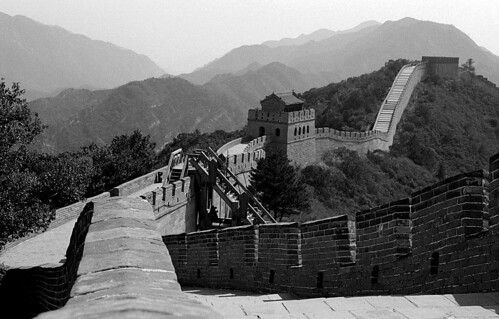
The Great Wall of China, one of the greatest wonders of the world, was enlisted in the World Heritage by UNESCO in 1987. Just like a gigantic dragon, the Great Wall winds up and down across deserts, grasslands, mountains and plateaus, stretching approximately 6,700 kilometers (4,163 miles ) from east to west of China. With a history of more than 2000 years, some of the sections of the great wall are now in ruins or even entirely disappeared. However, it is still one of the most appealing attractions all around the world owing to its architectural grandeur and historical significance.
Showing posts with label History of the Great Wall. Show all posts

About The Great Wall of China

The Great Wall of China is the longest structure in the would; like the Pyramids of Egypt, the Taj Mahal in India and the Hanging Garden of Babylon, is one of the seven great wonders of the world. The Great Wall of China is very important to all Chinese, it’s not only the magnum opus of human being but also the soul of China!
greatwall  The Great Wall is very long, it crossed more than half of China. The Great Wall is starting out in the east on the banks of the Yalu River in Liaoning Province. The Wall stretches westwards for 12,700 kilometers to Jiayuguan in the Gobi desert, thus known as the Ten Thousand Li Wall in China. The Wall climbs up and down, twists and turns along the ridges of the Yanshan and Yinshan Mountain. Chains through five provinces—Liaoning, Hebei, Shanxi, Shaanxi, and Gansu—and two autonomous regions--Ningxia and Inner Mongolia, binding the northern China together(China Through A Lens).

Great Wall is most build cross plains, mountains, and plateaus. Parts of the Great Wall are crossed the desert. “One of the highest sections of Great Wall is on the Badaling mountain, near Beijing. This section is about 35 feet, which is about 11 meters high, the wide at its base is about 25 feet(7.6 meters) and near 20 feet (6 meters) on the top. The watchtowers stand about 100 to 200 yeads (91 to 180 meters) apart along the wall. (Kai-Wing, Chow).” Watchtowers were made for people to look out at war time, so they can know when enemies come. It is about 40 (12 meters) feet high. Thousands of years ago, Chinses people began to build the Great Wall. The building of the Great Wall was begin as early as the 600’s BC, at that time, the Great Wall was built to protect Chinese against invaders. Qin Shi huang, Emperor of Qin dynasty is the first ruler to conceive of the Great Wall. The building continued including the Han and the Sui dynasties. When the Ming dynasty bagan in 1369, much of the Great Wall have been crumbled. Because of the growing threat of a Mongol invasion, the Ming government began to build a major wall in late 1400’s. This is most of the wall that remains today. Like the earlier one, it protected China from attacktion and it also provided defense against a major invasion. Through the years, much of the Great Wall collapsed again. And the Chinese Communist have done all the restoration works since 1949(China Through A Lens).
greatwall of China
greatwall of China The wall is about 4,000 miles long. And it is simple in structure. The Great Wall is built out of dirt, stone, and brick.() Most of the Great Wall is carried out by humans, and a lot of people died because of the building of the Great Wall(Aladdin, Paperbacks).

“Its height ranges from 15 to 30 feet, with watchtowers rising at regular intervals above it. It is 15 to 25 feet wide. Along the top runs a 13-foot-wide roadway. Behind the wall there are at intervals permanent camps for troops.”(Tim, McNeese).

Today, the Great wall has lost its strategic importance and has become a world-renowned tourist attraction.

As a cultural heritage, the Wall belongs not only to China but to the world. The Venice charter says: “Historical and cultural architecture not only includes the individual architectural works, but also the urban or rural environment that witnessed certain civilizations, significant social developments or historical events." The Great Wall is the largest of such historical and cultural architecture, and that is why it continues to be so attractive to people all over the world. In 1987, the Wall was listed by UNESCO as a world cultural heritage site.

History of the Great Wall of Sui Dynasty

Emperor Wendi (Yang Jian) who ruled from 581 to 604 was the first emperor of the Sui Dynasty. He usurped the throne of the Northern Zhou Dynasty and established the Sui Dynasty in 581. The Sui Dynasty lasted for only two generations spanning 38 years. However, in this period several sections of the Great Wall were built.

Adopting the well-established administrative systems of the Northern Zhou, the Sui proceeded to bring down the Chen Dynasty of the Northern and Southern Dynasties and so created a united China and bringing to an end an era of chaos that had endured for 270 years. Following unification, the feudal separatism that had lasted in China for four hundred years also came to an end.

The new imperial government set about the prevention of invasion from the northern nomadic peoples such as the Turkic People and Qidan People. In 583, the Turkic People, a nomadic tribe that inhabited land to the north of the Sui territory, split into the Eastern and the Western factions due to inner confliction. However, the Turkic tribe continued to attack the Sui's northern boundary.
great wall of china
Great Wall
great wall of china
Great Wall
A labor force numbering many hundreds of thousands was gathered to work on the construction of the Great Wall. Historical records show us that the Sui Dynasty undertook six such major construction projects in total.

Four construction projects were completed during the reign of Emperor Wendi.

1). In April of 581, the first section of the Sui Dynasty Great Wall was built. This project took only twenty days but in December, the eastern sections of the Great Wall attributable to the Northern Wei and the Northern Qi were repaired.
2). Historical research shows that a section was started in 585 from the east bank of the Yellow River near Lingwu County in Ningxia Hui Autonomous Region, through Hengshan County to Suide County of Shaanxi Province. This ran for about 350 kilometers (217 miles) from west to east.
3). In 586, a twenty-day repair was undertaken. In addition, construction of several fortresses was commenced along the Great Wall to the east of present Hengshan County of Shaanxi Province in order to protect the Sui border in that region.
4). In 587, a further section of the Great Wall was constructed but there is no surviving record providing detailed information about this.

When Emperor Yangdi came to the throne in 604, he instigated two more Great Wall construction projects.

1). During 607, a labor force of millions was levied to extend the Great Wall from the east of today's Youyu County of Shanxi Province to the southwest of Toketo County of Inner Mongolia.
2). The other section commenced at Xining City of Qinghai Province in the west, but the location of the eastern extremity of this section is not recorded.

These two sections of the Great Wall had no strategic purpose beyond displaying the military power that prevailed during the rule of Emperor Yangdi.
great wall of china
Great Wall

History of the Great Wall of Northern and Southern Dynasties

The Three Kingdoms Period (220-280) and the Jin Dynasty (265-420) after the Han Dynasty (206BC-220) were suffered by contending battles. Due to the battles and inner conflicts, no walls were built during the two dynasties.

Subsequently, the Northern and Southern Dynasties (420-589) coexisted. The dynasties of Song, Qi, Liang, and Chen, the Southern Dynasty (420-589), took Jiangkang (present Nanjing City of Jiangsu Province) as their capital. The dynasties of the Northern Wei, the Eastern Wei, the Western Wei, the Northern Qi, and the Northern Zhou were called the Northern Dynasty (386-581). During this period, the dynasties of the Northern Wei, the Eastern Wei, the Northern Qi, and the Northern Zhou had the Great Wall built and extended.

Great Wall of the Northern Wei Dynasty (386-534)

Tuoba Gui, the chieftain of Xianbei people, the most important and largest nomadic tribes of the steppe region north of China during the Northern and Southern Dynasties, established the Wei Dynasty in 386, later called the Northern Wei. At that time, its northern Rouran people, a nomadic tribe living north of the Northern Wei, became increasingly powerful. To thwart their advance, in 423 the Northern Wei Dynasty built about 1,000 kilometers (621 miles) of the Great Wall to its northern boundary and set up garrisons to prevent invasion by the Rouran.

This section of the Great Wall started from Chicheng County of Hebei Province, through the north of Shanxi Province and ended in Wuyuan County of Inner Mongolia. Emperor Taiwudi, ruler at the height of Northern Wei military strength, ended the unification war at the Yellow River Valley, defeated his powerful enemy, the Rouran, and established six important garrisons north of the Great Wall to protect Pingcheng City (present Datong City), capital of the Northern Wei.

The Northern Wei also built the inner wall (Sai Wei), an earth wall lower and thinner than the Great Wall, to supplement the Great Wall. The Sai Wei was also built to protect Pingcheng City. It started from present Shanxi Province, along the boundary of Shanxi and Hebei provinces and reached Tianzhen County of Shanxi Province, circled Datong City and ended at the east bank of the Yellow River. It stretched for about 500 kilometers (311 miles) long.

Great Wall of the Eastern Wei Dynasty (534-550)

The Northern Wei divided into Eastern and Western Wei. To prevent intrusion by the Rouran, in 543 the Eastern Wei built a section of the Great Wall from today's Jingle County to Chunyang County of Shanxi Province, stretching about 75 kilometers (47 miles). While not very long; it is the passage through which northern nomadic peoples entered China. The Eastern Wei built this section of the Great Wall to consolidate the northern boundary and to prevent intrusion by nomadic people.

Great Wall of the Northern Qi Dynasty (550-577)

The Northern Qi Dynasty was founded after defeat of the Eastern Wei in 550. During the short period of reign, the dynasty area was frequently invaded by northern nomadic peoples such as the Rouran, Turkic, and Qidan, and was threatened by Western Wei and Northern Zhou. So the Northern Qi rebuilt the Great Wall many times.

During 552, the first part of the Great Wall of the Northern Qi was built to prevent invasion by the Western Wei. This section ran south to north, from today's Lishi County to Shuoxian County of Shanxi Province, stretching about 200 kilometers (124 miles).

Turkic people of the Mongolian Plateau became increasingly powerful, establishing the Turkic Dynasty during the reign of the Northern Qi., often invading the northern boundary of the Northern Qi. So the Northern Qi had to accelerate its pace in the construction of the Great Wall. A section of 450 kilometers (279 miles) was built in 555 starting from the south gate of present Juyongguan Pass and ending in Datong of Shanxi Province at the west.

Not only were two sections of the Great Wall built in 552 and 555, but during 556 a new section was built eastwards reaching Shanhaiguan Pass. The whole Great Wall was then about 1,500 kilometers (932 miles) long, which was longer than those of former dynasties except Qin and Han.
great wall of china
Great Wall
great wall of china
Great Wall

In 557 a defense line was built inside the Great Wall. The section started east of Pianguan Pass in Shanxi Province, passing the eastern Yanmenguan Pass, and Pingxingguan Pass and then reaching Xiaguan Pass of Shanxi Province. The other section, starting from Niangziguan Pass, passing Malingguan Pass and ending at Huangyangguan Pass no longer exists; only some relics remain.

In 563 another section of the Great Wall was built along Mt. Taihangshan at the junction of Shanxi and Hebei Provinces. Some parts remain at the top of Mt. Taihangshan. A well-preserved section ran from west of Longquanguan Pass to west of Xiakou town, Jianping County of Hebei.

Because in 563 Turkic people launched two hundred thousand soldiers to destroy the Great Wall and prepared to invade Pingcheng City, the Northern Qi extended the Great Wall of the Eastern Wei to Yanmenguan Pass in 565 and mended the inner Great Wall built in 557. In addition, a section of the Great Wall was extended from Xiaguan Pass of Shanxi Province to its east end, Juyongguan Pass. A section between Juyongguan Pass and Shanhaiguan Pass was rebuilt.

Great Wall of the Northern Zhou Dynasty (557-581)

By defeating the Western Wei, the Northern Zhou Dynasty was established in 557. At its height, it defeated the Northern Qi in 577 and unified the north of China. Meanwhile, the Turkic people north of the Northern Zhou became stronger and frequently intruded into Northern Zhou areas. Emperor Jingdi had the Great Wall of the Northern Qi renovated in 579.
great wall of china
Great Wall

History of the Great Wall Jin Dynasty

After the short-lived Sui Dynasty came the glorious Tang Dynasty (618-907). The whole period of the Tang Dynasty was a time of economic and cultural prosperity. During this period there was little or no threat from beyond the national borders, so no additional fortifications were deemed necessary. With the collapse of the Tang Dynasty and the subsequent fragmentation of the country the succeeding dynasties continued to focus on cultural development. The Song Dynasty (960-1279), although obliged to adopt a defensive stance against the dynasties of Liao (907-1125), Western Xia (1032-1227), and Jin (1115-1234), did not build fortification walls.

According to historical records, in 908 a section of the Great Wall on the Nanguanling Town of Liaoning Province at the confluence of the Bohai Sea and the Yellow Sea (Huanghai Sea) was built during the Liao Dynasty (907-1125). In 1026, the nomadic Nuzhen who occupied territory to the northeast of China built several fortresses and beacon towers to prevent invasion. The fortresses and beacon towers formed part of the defense system of the Great Wall. At this time the Wall stretched from White City (Bai Cheng) Village of Acheng City of Heilongjiang Province in the north to Nongan County of Jilin Province in the south.

The Great Wall of the Jin Dynasty

In 1115, the Nuzhen nomadic established the Jin Dynasty (1115-1234). In order to prevent incursion from their neighbors, the Mongols, a large construction program was launched. The records show that two important sections of the Great wall were completed.

The Wall as constructed by the Jin differed from the previous sections. Known as the Border Fortress or the Boundary Ditch of the Jin, it was formed by digging ditches within which lengths of wall were built. In some places subsidiary walls and ditches were added for extra strength. The construction of the Great Wall by the Jin Dynasty was started in about 1123 and completed by about 1198. The two sections attributable to the Jin Dynasty are known as the Mingchang Old Wall and the Mingchang New Wall.

The Mingchang Old Wall: Also called the Border Fortress of the Jin, this section is located to the north of the Mingchang New Wall. It is near today's Heilongjiang River northwest of the Xing'an Mountains in Heilongjiang Province. It stretched about 500 kilometers (311 miles).

The Mingchang New Wall: Also called the Inner Wall of Jin, it was also built to prevent attack from the Mongols, the whole wall stretched about 1,500 kilometers (932 miles), starting from Hetao area of Inner Mongolia at the west, passing provinces and autonomous regions such as Shaanxi, Shanxi, Hebei, Inner Mongolia, Liaoning and Heilongjiang and ending at the Songhua River of Heilongjiang Province.
great wall of china
Great Wall

Today, the site of the Great Wall of the Jin Dynasty can be found in Xilinhaute City of Xilin Gol League of Inner Mongolia.

With the advent of the Mongol Yuan Dynasty (1279-1368), there was no further need to extend the border defenses, as their territory spanned parts of both Europe and Asia. The next era of construction was to follow when the rule of the Ming was established.
great wall of china
Great Wall
great wall of china
Great Wall

History of the Great Wall -Ming Dynasty Great Wall

The Great Wall as it exists today was built mainly in the Ming Dynasty (1368 - 1644). It was an ambitious project and took over 100 years to complete. The walls of this period were well designed and known for their unique configuration and effective defense system. Extending from the Yalu River in Liaoning Province to the eastern bank of the Taolai River in Gansu Province, Ming's Great Wall winds its way from east to west through present Liaoning, Hebei, Tianjin, Beijing, Inner Mongolia, Shanxi, Shaanxi, Ningxia and Gansu Provinces or areas.
great wall of china
Great Wall

Research has shown that Ming's emperors were busy with the construction of this wall throughout their reign. After seizing political power from rulers of the Yuan Dynasty (1271 - 1368), the emperors had to battle desperate Yuan forces in the north and stop the threat of invasion from other northern ethnic tribes such as Nuzhen, Dada and Wala. To resist these outside forces and protect their citizens, every emperor of the Ming Dynasty spared no effort in building, fortifying, extending and eventually completing the Great Wall.

The design of the Ming Wall was well thought out. For example, Xuanfuzhen Great Wall in Beijing, due to its strategic position, was built in the unique style of double lines, inner and outer, to strengthen its defensive ability. A total of six passes were built. The inner passes were Juyongguan Pass, Zijingguan Pass and Daomaguan Pass, and the outer passes were Pianguan Pass, Ningwuguan Pass and Yanmenguan Pass. These passes controlled entries and exits into the areas and are secured by gates. Watch towers, signal towers, fortresses, and observation posts serve as additional reinforcements. The Ming Wall was further divided into nine zones, each controlled by a garrison, called 'zhen' in Chinese. Two more garrisons were added later, making a total of eleven garrisons. This ensured the security of the capital.

Following the topographies of the land through which it travels, this ancient wall looks like a long winding dragon. To get a rough idea of the size: if all its stones, bricks, and earth are used to build a city wall of 1.1 yards high and 5.5 yards wide, the total length of this wall will circle the earth more than once. Today, remnants of this huge wall stand as a witness to the sacrifices of the ancient builders and the wisdom of its designers. It is perhaps one of the greatest architectural achievements of men.
great wall of china
Great Wall
great wall of china
Great Wall

History of the Great Wall of Han Dynasty

Han Dynasty was divided into two historical periods: Western Han (202BC-24AD) and Eastern Han (25AD-220AD). The capital of Western Han was at present Xian of Shaanxi Province and the capital of Eastern Han was at present Luoyang City of Henan Province.great wall of china
Great Wall

Liu Bang (256BC-195BC) took the title of Han Gaozu, the first emperor of Han Dynasty (202BC-220AD), when he ascended the throne after defeating Xiang Yu in 202BC. That was right after the brief Qin Dynasty, which had imposed a centralized government on China. But the new nation was no match for the fierce Huns, who had constantly invaded its northern borders. Early Han administrators had no choice but sued for peace, and sent Chinese princesses north as Hun nobles' brides.

By 140 BC, under Liu Che (156BC-87BC), the emperor Han Wudi brought war home to the Huns. He also had several parts of the Great Wall built.

Han Wudi ordered a construction project of the Great Wall in 127 BC. This resulted in rebuilding an older part of the Wall and an extension of territories to present day Mount Yinshan of Inner Mongolia.

Huo Qubing, Emperor Han Wudi's general pushed the Huns back and in 121 BC he secured the Hexi Corridor, the passage to the Western Region. A subsequent Hexi wall construction from present day Yongdeng County to Jiuquan City in Gansu Province had severed contacts between Huns and their allies the Qiang People. The newer wall had joined the eastern terminus of an older network of walls.

Forts dotted the distance between Jiuquan City and Yumenguan Pass of Gansu Province that were also the form of the Great Wall. These were measures against Hun warlords around 110 BC. Around 101 BC Chinese workers built the section from Yumenguan Pass to Luobu Po of Xinjiang Ugyur Autonomous Region. Altogether Han Wudi had built a thousand kilometers (621 miles) of defense wall over twenty years to secure the passage to the Western Region. The Huns power later was in decline and consequently less wall-building activity came about this side of the border.

During the period of Eastern Han, after years of civil wars, Liu Xiu (6BC-57AD), the emperor Guang Wudi could put up only weak resistance to northern invaders. In around 39 AD he gave order to his general Ma Cheng to build four boundary walls to contain the damage. The boundary walls ran 1) from Lishi County of Shanxi Province to southeast of Xianyang City of Shaanxi Province; 2) between Gaoling County of Shaanxi and Anyi County of Shanxi; 3) from Taiyuan City of Shanxi to Jingxing County of Hebei Province; and 4) from Dingxian County of Hebei to Linhang County of Henan Province.

The walls offered some protection to Luoyang, the capital of Eastern Han. Afterwards in-fighting divided the Huns into the North and South. The North Huns were driven off by Han. The more friendly South Huns co-existed with the Han Dynasty and there was no need to build more walls.

History of the Great Wall of Qin Dynasty

In the year 221 BC, Emperor Qin Shihuang defeated all his enemies and unified China for the first time in its history. During his reign, the Huns from the north were a constant threat, often coming down to the Yellow River Basin and taking land from people in the Hetao Area, located at the top of the Great Bend of the Yellow River in Ningxia and Inner Mongolia. To protect his people and safeguard his political power, the Emperor ordered General Meng Tian, commanding 300,000 soldiers, to defeat the enemy force. To prevent further attacks by the Huns, he decided to consolidate and extend the Great Wall.

Many people believed that it was Emperor Qin Shihuang who first built the Great Wall. But research showed that before Qin's Great Wall, the six ducal states had already built their own walls to prevent attacks from each other and the Huns. Qin's Great Wall was built by connecting parts of the walls belonging to the past ducal states Qin, Zhao and Yan, plus adding several thousand miles of its own. The Great Wall of Qin resembled a gigantic dragon, extending from Lintao in the west to Liaodong in the east. Thus it was named 'Wanli Changcheng' (Ten Thousand Li Great Wall)
great wall of china
Great Wall
great wall of china
Great Wall

Generally speaking, Qin's Great Wall can be divided into three sections: western, middle and eastern. The western section started from the present Min County in Gansu Province, winding its way to Inner Mongolia via Guyuan County in Gansu Province; Jingbian, Yulin, Shenmu in Shaanxi Province; ending at the south bank of the Yellow River. The middle section started from Xinghe County in Inner Mongolia, winding its way to the north border of Wulanbuhe desert by way of Daqingshan Mountain, Guyuan County, Yinshan Mountain and the Yellow River. This part of the Great Wall was built mainly by using rubbles left from existing walls. The eastern section started from Huade County, Inner Mongolia, through Hebei Province, ending in Fuxin City in Liaoning Province. This part of the wall was built on the foundation of the ruins of Yan Dynasty walls.

It took about nine years to finish this grand project. The construction of the Qin Great Wall took many lives and a great deal of money and materials. From a historical aspect, during Qin Shihuang's rule, the Great Wall had served its role as a defensive force to protect people from wars and ensured them a peaceful and stable society.great wall of china
Great Wall
great wall of china
Great Wall

History of the Great Wall: Wall of Zhou


Great Wall

The Great Wall of Zhou Dynasty

The Zhou Dynasty is traditionally divided into two periods: Western Zhou (11th century BC-771BC) and Eastern Zhou (770BC-221BC). And the Eastern Zhou has two periods: the Spring and Autumn Period (770BC-476BC) and the Warring States Period (476BC-221BC).
History of the Great Wall
Spanning 2,700 years of Chinese history, ranging from the Spring and Autumn Period and the Warring States Period to the Ming Dynasty (1368-1644), over twenty states and dynasties were involved in the building of the Great Wall. The creation of the Great Wall was initiated during the Spring and Autumn Period and the Warring States Period to prevent the invasion by other states of China and outer tribes.

Walls Built in the Spring and Autumn Period (770 BC - 476 BC)

The Wall of Chu State

According to historical records, the first part of the Great Wall of China was built by Chu State. Chu State was a small state that gradually developed by conquering weak neighbors during the Spring and Autumn Period. To control China and prevent the intrusion of the Jin and Qi states, Chu State built a series of walls along its northern frontier in about 656BC. These boundary markers would eventually evolve into the Great Wall. Shaped like a "U", the Wall of Chu was referred to as "the Rectangle Wall".

Entering the Warring States Period, Chu State extended its wall to guard against the attack from other states especially the mighty Qin. As such, the wall of Chu became more integrated and solid. At this point, the site now included the Lushan and Yexian Counties of Pingdingshan City, Wugang City, Fangcheng and the Nanzhao Counties of Nanyang City in Henan Province.

The Wall of Qi State
Great Wall
great wall of china pictures
Great Wall
great wall of china pictures
Great Wall
great wall of china pictures
Great Wall

Qi State was another state that participated in the building of the wall. Qi construction of the Wall commenced in the middle of the Spring and Autumn Period and finished in the middle of the Warring States Period. The whole construction lasted 300 years covering a length of 600 kilometers (372 miles). That was later called the Famous Wall of Qi.

Similar to Chu State, Qi State built the fortification to prevent intrusion by other states and outer tribes. It became one of the most influential military defenses in Chinese history. Its ramparts, passes, fortresses and beacon towers formed an integrated military defense system around which important historical events and campaigns were held.

The Wall of Qi stretched across almost the whole of Shandong Province, from the west in Changqing County to the east in Jiaonan County, passing through eight cities to reach the Yellow Sea of China.

With the development of Chinese society, the defense function of the Wall of Qi no longer exists. Only relics are left.

Walls Built in the Warring States Period (476BC-221BC)

Battles during the Spring and Autumn Periods and the Warring States Period occurred very often, particularly during the period of the "Seven Powers of the Warring States Period". Each state was eager to set the boundaries of its territory. To defend the state against invasion, they each built defense walls. With the increasing heat of the battles, the walls were continuously extended. The "Seven Powers" of Qin, Qi, Chu, Han, Yan, Zhao and Wei each built or extended their walls. Except for the Walls of Chu in the Yangtze River valley, all the others were in the Yellow River valley and Northern China areas.
great wall of china pictures
Great Wall
the great wall of china,
Great Wall
the great wall of china,

The Wall of Qin State

During the early Warring States Period, Qin State suffered from a weak economy, civil strife and repeated invasions by Wei State. To protect Qin State, the kings, Qin Ligong and Qin Jiangong successively, built the wall to the west of the Yellow River and the Luo River - a site that can now be found in Northern Shaanxi in Shaanxi Province.

An additional section of the wall was built along the northwest frontier of the state by King Qin Zhaogong. To the northwest of Qin State lay the Yiqu, a branch of the ancient Chinese Xirong people. Powerful during the Spring and Autumn Periods, these people held battles with the Qin from time to time. To guard against the intrusion of the Yiqu, King Qin Huiwen built the fortification along the north of his frontier. However, it was not until the period of King Qin Zhaogong that the Yiqu were completely defeated and the wall of Qin was built. These sites now lie in Gansu Province and Ningxia Hui Autonomous Region.

The Wall of Zhao State

According to historical record, the Wall of Zhao State was built in two sections. One section was built to the south of Zhao State in 333BC to prevent attacks from Wei and later the strong Qin. The whole wall was about 200 kilometers (124 miles) long and its site can now be found in Linzhang County and Cixian County of Hebei Province.

The other section was built in 300BC by King Zhao Wuling to prevent attacks from the Hu people. King Zhao Wuling was a wise king that made great efforts to make reforms and promote the culture exchange of different nations. He learned from the Hu people on one hand, and fought against the invasion of Hu people on the other. This section of the wall was located in what now is Inner Mongolia in China.

The Wall of Zhongshan State
Great Wall
great wall of china
Great Wall
great wall of china
Great Wall
Zhongshan State was a small but powerful one. During the Warring States Period, Zhongshan was aligned with the Yan and the Qin, its northern and eastern neighbors, and experienced a long and peaceful period. However its southwestern neighbors, the Zhao and Wei states, considered it a serious danger. So Zhongshan built the wall in 369BC to protect itself.

The Wall of Zhongshan was at the junction of Hebei Province and Shanxi Province of China. It ran over Mt. Hengshan, across Mt. Taihangshan and finally reached the Xingtai area of Hebei Province, stretching about 250 kilometers (155 miles).

The Wall of Wei State

The Wall of Wei had two sections: the first was the Hexi Wall located in the northwest of Wei, and it was originally built to guard against the mighty Qin. The other was the Henan Wall in the south. The sites are located in now Huayin City, Hancheng City and Dali County in Shaanxi Province. Starting at the foot of Qinling in Huayin, the Wall stretched to Dali, Chengcheng and Heyang in the north and Hancheng in the east, through the Loess Altiplano to Inner Mongolia, and at last ended in Guyang, Baotou. It spanned more than 200 kilometers (124 miles). The longest and best preserved part ran about 2.1 kilometers (1.3 miles), with a height of 2.2-11.4 meters (7.2-37.3 feet) and a width of 6-16 meters (19.7-52.4 feet). Today, only one or two sections remain including a fortress and beacon tower at a height of 7-11 meters (23-36 feet).

The Wall of Zhenghan State

This part of the Wall was originally built by Zheng State in 355BC. After the Zheng were conquered by the Han, Han State continued to build and use the Wall. Some call this section the Wall of Han, while others call it the Wall of Zheng - hence the creation of the shared name Wall of Zhenghan. This part of the Wall connected with the southeastern Wall of Wei, and can be found in present Xinzheng City in Henan Province, once the capital of the Zheng and Han.

The Wall of Yan State

The Wall of Yan State also had two sections: the Wall of Yishui and the Wall of the North. Construction of the Wall of Yishui, from 334BC to 311BC, was done to guard against the attack from the Zhao, Qi and Qin. It stretched about 250 kilometers (155 miles) from the foot of present Mt. Taihangshan of Yixian County through Xushui and Anxin Counties, via XiongXian County and ended in Wen'an County in Hebei Province.

The Wall of the North was built to guard against intrusion by nomadic people like the Donghu. This part of the wall was built in 254BC, which was the last wall built in the Warring States Period. This wall went through present Zhangjiakou City of Hebei Province, Inner Mongolia, across Hebei Province, Chaoyang City of Liaoning Province, over Mt. Yiwulu Shan, and reached Liaoyang of Liaoning Province. Now the sites of Wall of Yan can be found in the above-mentioned areas.

Main history of the Great Wall of China

The history of the Great Wall is said to start from the Spring and Autumn Periods when seven powerful states appeared at the same time. In order to defend themselves, they all built walls and stationed troops on the borders. At that time, the total length of the wall had already reached 3,107 miles, belonging to different states.

In 221 BC, the Emperor Qin absorbed the other six states and set up the first unified kingdom in Chinese history. In order to strengthen his newly born authority and defend the Huns in the north, he ordered connecting the walls once built by the other states as well as adding some sections of his own. Thus was formed the long Qin's wall which started from the east of today's Liaoning Province and ended at Lintao, Gansu Province.

In the Western Han Dynasty, the Huns became more powerful. The Han court started to build more walls on a larger scale in order to consolidate the frontier. In the west, the wall along the Hexi corridor, Yumenguan Pass, and Yangguan Pass was built. In the north, Yanmenguan Pass and Niangziguan Pass in Shanxi were set up. Many more sections of the wall extended to Yinshan Mountain and half of the ancient Silk Road was along the Han's wall.

The Northern Wei, Northern Qi and Northern Zhou Dynasties all built their own sections but on a smaller scale than the walls in the Han Dynasty. The powerful Tang Dynasty saw peace between the northern tribes and central China most of the time, so few Great Wall sections were built in this period.

The Ming Dynasty is the peak of wall building in Chinese history. The Ming suffered a lot by disturbances from minority tribes such as the Dadan, Tufan and Nuzhen. The Ming court from its first emperor to the last ceaselessly built walls in the north. The main line started from Jiuliancheng near the Yalu River in the east to the Jiayuguan Pass in the west and measured over 4,600 miles. Besides adding many more miles of its own, the Ming emperors ordered enlargement of the walls of previous dynasties into double-line or multi-line walls. For example, out of Yanmenguan Pass were added three big stone walls and 23 small stone walls. Eleven Garrisons were distributed along the main line of the wall. The countless walls, fortresses, and watch towers made the country strongly fortified. In the early Qing Dynasty, some sections of the walls were repaired and several sections were extended. This great engineering work stopped in the middle of the Qing Dynasty.

Owing to its long history, natural disasters and human activities, many sections of the Great Wall are severely damaged and disappearing. Being a world-famous engineering project and witness to the rise and fall of Chinese history, the Great Wall, needs us to take immediate action to protect it!

The detail history of great wall of china
  1. Wall of Zhou
  2. Wall of Qin
  3. Wall of Han
  4. Wall of Jin
  5. Wall of Northern and Southern
  6. Wall of Sui
  7. Wall of Ming
  8. Chronology

The Great Wall Construction Chronology


DynastyWallPeriodLength (Mile)Description
Warring States
(476 BC-221 BC)
Wall of Qi685 BC

-645 BC
385From the bank of Yellow River
to the Yellow Sea in the east
Wall of Chu656 BC155Started from the northeast of Dengzhou in Henan Province,
northward via the border of Neixiang and Zhenping Counties,
eastward along Funiu Mountain to the west of Ye County, and
southeastward to Zhongyang Mountain in Qinyang County
Wall of Yan334 BCUnknownStarted from the Taihang Mountain of Hebei Province, arriving
at the northeast of Xiong County via Xushui and Anxin Counties,
and southward to Ziya River
Wall of Qin (under the reign of King Li Gong)461BCUnknownStarted from the Xiaozhang Village at the foot of Mt. Huashan
in Shaanxi Province, northeastward to the bank of Weihe River,
westward along the south bank of Luohe River to Pucheng County,
and ended at Mt. Huanglong in Baishui County along the west
bank of Luohe River
Wall of Qin (under the reign of King Zhao)UnknownUnknownStarted from the Min County in Gansu Province, northward to
the present Lintao County, reached the border area of Tianciwan
Village in Jingbian County of Shaanxi Province and Liandaowan
Village in Ansai County of Shaanxi Province. From here, the
wall branched out into two paths.The first was built eastward
along the dividing range of Dali River and Huaining River and
ended at Yuhe Village in Yulin City (Shaanxi). The other turned
to the north by way of Jingbian County, Yulin City to the west
bank of Yellow River, south of Inner Mongolia
Wall of Zhao300 BCUnknownStarted from the border of Mt.Wula and Mt.Langshan, gets to
the north slope of Mt. Daqing in the northwest of Hohhot via
the south slope of Mt. Yinshan, Wuyuan County (Inner Mongolia)
and Guyang County (Inner Mongolia)
Wall of Wei (the west line)361 BC -352 BCOver 62,137Started from Mt. Huashan in Shaanxi Province and through to
the bank of the Yellow River by way of Weihe River, Dali County
(Shaanxi), northward to the Heyin and Hancheng Counties (Shaanxi)
Wall of Wei (the south line)UnknownUnknownStarted from today's Yuanyang County in Henan Province, and
ended at Mixian County (Henan) via Yangwu County (Henan) and
east of Zhengzhou
Qin (221 BC-206
BC)
Wall of Qin (the west line)214 BC3,107Started from the Minxian County in Gansu Province, and ended
at the south bank of the Yellow River by way of Lintao County
(Gansu), Jingbian County (Shaanxi), Hengshan Mountain, Yulin
City (Shaanxi) and Tuoketuo County in Inner Mongolia
Wall of Qin (the north line)214 BCStarted from the west section of Mt. Yinshan and ended at
the mouth of today's Qingchuan River in North Korea by way of
the north slope of Mt. Daqing, Jining County in Inner Mongolia,
Zhangyi County (Hebei), Fushun and Benxi Cities (Liaoning)
Western Han
(206 BC-24)
Wall of Western Han205 BC6,214The first emperor (Liu
Bang) ordered the restoration of the Qin Wall
130 BCEmperor Wu (Liu
Che) ordered restoration of the wall on a larger scale
121 BCThe emergence of Wuwei and Jiuquan Counties. Lingjusai Great
Wall, the first section of the Hexi Great Wall, started at the
west bank of the Yellow River in today's Yongdeng County (Gansu
Province) to the Jinta County in northern Jiuquan City along
the Hexi Corridor
127 BCEmperor Wu ordered extension of the wall to today's Jiuquan
City
111 BCEmperor Wu ordered extension of the wall to Yumen, which
was the second section of the Hexi Great Wall
102 BCEmperor Wu ordered to build the wall from Yumen to Luobupo
in Xinjiang, which was the third section of the Hexi Great Wall
Northern Wei (386-534)Wall of Northern Wei423621Started from the northeast of Chicheng County and ended at
Mt. Yinshan via Zhangbei County (Hebei), Shangyi County (Hebei),
Huade, Shangdu, Wuchuan and Guyang Counties (Inner Mongolia)
Northern Qi
(550-577)
Wall of Northern Qi552124Started from today's Lishi County (Shanxi) and ended at today's
Wuzhai County (Shanxi) along Mt. Luliang
555Over 280Started from Xiakou near Juyongguan
Pass and ended at Hengzhou County (today's Datong County
in Shanxi Province)
556932Started from today's Fenyang County (Shanxi) and stretched
to the seashore near Shanhaiguan
Pass
557124Started from the border of today's Daixian and Shuoxian Counties
(Shanxi) and ended at the southwest of today's Lingqiu County
(Shanxi)
56362Located at today's northwest of Jiyuan County in Henan Province
Sui (581-618)Wall of Sui581-608932Started from the bank of the Yellow River in Ningxia and
zigzagged to the coast of Bohai Sea by way of Inner Mongolia,
Shanxi and Hebei Provinces
Liao (916-1125)Wall of Liao908UnknownLocated at today's Mt. Nanguan in today's Dalian City, Liaoning
Province
Jin (265-420)Ditches of Jin1148UnknownStarted from today's Genhe City in Inner Mongolia and ended
at the Mt. Kente, Mongolia
Ming (1368-1644)The Great Wall of Ming1368-16444,536Started from Yalu River in Liaoning Province and ended at
Jiayuguan
Pass in Gansu Province by way of Hebei, Tianjin, Beijing,
Shanxi, Inner Mongolia, Shaanxi, and Ningxia